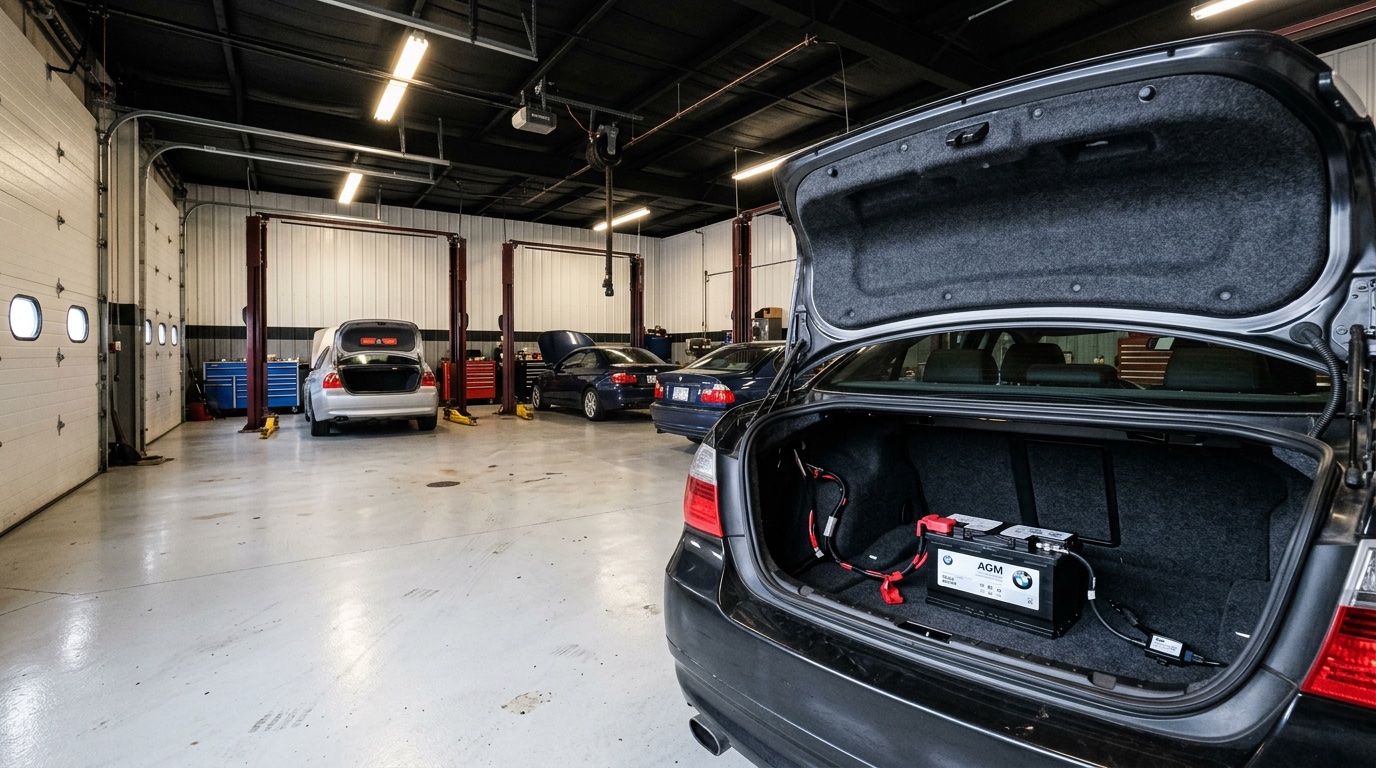
You'd think replacing a car battery would be simple — unbolt the old one, bolt in the new one, done. On most cars, that's exactly how it works. On a BMW? Not even close. Every BMW built after roughly 2002 requires electronic battery registration after a battery swap. Skip this step, and you're setting yourself up for a cascade of electrical problems that can cost far more than the battery itself.
At Highline Motorsports, battery registration is one of the most common services we perform — and one of the most commonly skipped by DIYers and general shops that don't understand BMW's power management system.
What Is Battery Registration?
Battery registration is the process of telling the car's DME (engine control unit) that a new battery has been installed. This isn't just a formality — it fundamentally changes how the vehicle manages electrical power. When you register a new battery, the DME:
- Resets the charge counter — the DME tracks how many charge/discharge cycles the battery has been through
- Updates the battery capacity profile — new batteries have different internal resistance than aged ones
- Adjusts the charging voltage — the alternator output is tailored to the battery's current condition
- Recalibrates the IBS sensor — the Intelligent Battery Sensor gets a fresh baseline
- Records the battery type and capacity — AGM vs lead-acid, 80Ah vs 90Ah, etc.
The IBS Sensor: BMW's Battery Brain
The key to understanding BMW battery management is the IBS (Intelligent Battery Sensor). This small sensor is bolted directly to the negative battery terminal and continuously monitors:
- Battery voltage — real-time voltage readings
- Current flow — how much power is being drawn or charged
- Battery temperature — affects charging strategy and capacity calculations
- State of charge (SOC) — estimated percentage of remaining capacity
- State of health (SOH) — the battery's overall condition relative to new
The IBS feeds this data to the DME, which uses it to make hundreds of decisions per second about how to manage electrical load. The alternator output, idle speed, auto start-stop behavior, and even which comfort features remain active during engine-off periods are all governed by this data.
Key point: The IBS doesn't just monitor — it learns. Over the life of a battery, it builds a degradation model. When you install a new battery without registering it, the DME still thinks it's managing the old, degraded battery.
What Happens When You Don't Register
This is where things get expensive. When a new battery is installed without registration, the DME continues using the charging profile calibrated for the old, worn-out battery. Here's what that means in practice:
Overcharging
As batteries age, their internal resistance increases. The DME compensates by increasing charging voltage to push current through that higher resistance. When you install a fresh battery with low internal resistance but the DME is still pushing high voltage — the new battery gets overcharged. This causes excessive gassing, electrolyte loss, plate corrosion, and dramatically shortened battery life.
Premature Battery Failure
We routinely see BMWs come in with batteries that are only 12-18 months old but already failing. The owner replaced the battery themselves (or had a general shop do it), didn't register it, and the overcharging killed the new battery in a fraction of its expected lifespan. A properly registered AGM battery should last 5-7 years in a BMW.
Electrical Gremlins
Without proper registration, you may experience:
- Auto start-stop stops working — the DME thinks the battery can't handle restart loads
- Increased idle speed — the DME raises RPM to increase alternator output
- Comfort features disabled — seat heaters, entertainment system, and other draws may be restricted
- Dashboard warnings — "Increased battery discharge" messages that won't clear
- Poor fuel economy — the alternator runs at maximum output continuously

DME Adaptation and Charging Strategy
BMW's power management system uses a concept called closed-loop charging. Unlike conventional vehicles that run the alternator at a fixed voltage, BMW dynamically adjusts charging based on:
- Battery age and condition — newer batteries get lower charging voltage
- Driving patterns — frequent short trips trigger more aggressive charging
- Electrical load — more accessories active means more charging priority
- Temperature — cold weather requires different charging curves than warm
Registration resets all of these adaptations to match the new battery's actual characteristics. Without it, there's a fundamental mismatch between what the battery needs and what it's getting.
Which BMW Models Are Affected?
Essentially every BMW built after 2002 requires battery registration. This includes:
- E65/E66 7 Series (2002+) — the first generation to require it
- E60/E61 5 Series (2004+)
- E90/E91/E92/E93 3 Series (2006+)
- E70 X5 / E71 X6 (2007+)
- F-series vehicles (2011+) — F10, F30, F25, F15, etc.
- G-series vehicles (2019+) — G20, G30, G05, G06, etc.
The registration process has also become more complex with each generation. E-series BMWs typically require basic registration with battery type and capacity. F-series and G-series vehicles may require additional parameters including manufacturer codes and production dates.
DIY vs. Professional Registration
Can you register a BMW battery yourself? Technically, yes — if you have the right tools. But there are important caveats:
DIY Options
- Carly / BimmerCode apps — can perform basic registration on most models, but limited on newer vehicles
- ISTA (BMW dealer software) — full registration capability, but requires proper hardware and licensing
- Foxwell / Autel scanners — some models support BMW battery registration, results vary
What Can Go Wrong DIY
- Wrong battery type coded — coding an AGM as lead-acid (or vice versa) creates dangerous charging conditions
- Incorrect capacity entered — the DME builds its charging model around this number
- Incomplete registration — some tools don't reset all required parameters
- Tool compatibility issues — not all tools support all DME versions
Important: Using the wrong battery type or capacity during registration can be worse than not registering at all. If you're unsure, have it done by a specialist who works with BMW's systems daily.
Highline's Battery Registration Process
At Highline, battery registration is a standard part of every battery replacement we perform. Our process includes:
- Battery testing — we test the existing battery to confirm it actually needs replacement (not just a charging system issue)
- Correct replacement selection — matching the exact battery type, capacity, and group size specified for your vehicle
- Professional installation — proper torque on terminals, IBS sensor connection verified
- Electronic registration via ISTA — using BMW's own dealer-level software to register the new battery with correct parameters
- System verification — confirming charging voltage, IBS readings, and power management adaptations are correct
We also offer registration-only service for customers who have already installed a battery themselves and just need it properly coded to the vehicle. This is a quick appointment that can save your new battery from premature failure.
Need Battery Registration?
Whether you need a full battery replacement or just need a new battery registered to your BMW, Highline has you covered with dealer-level ISTA registration.