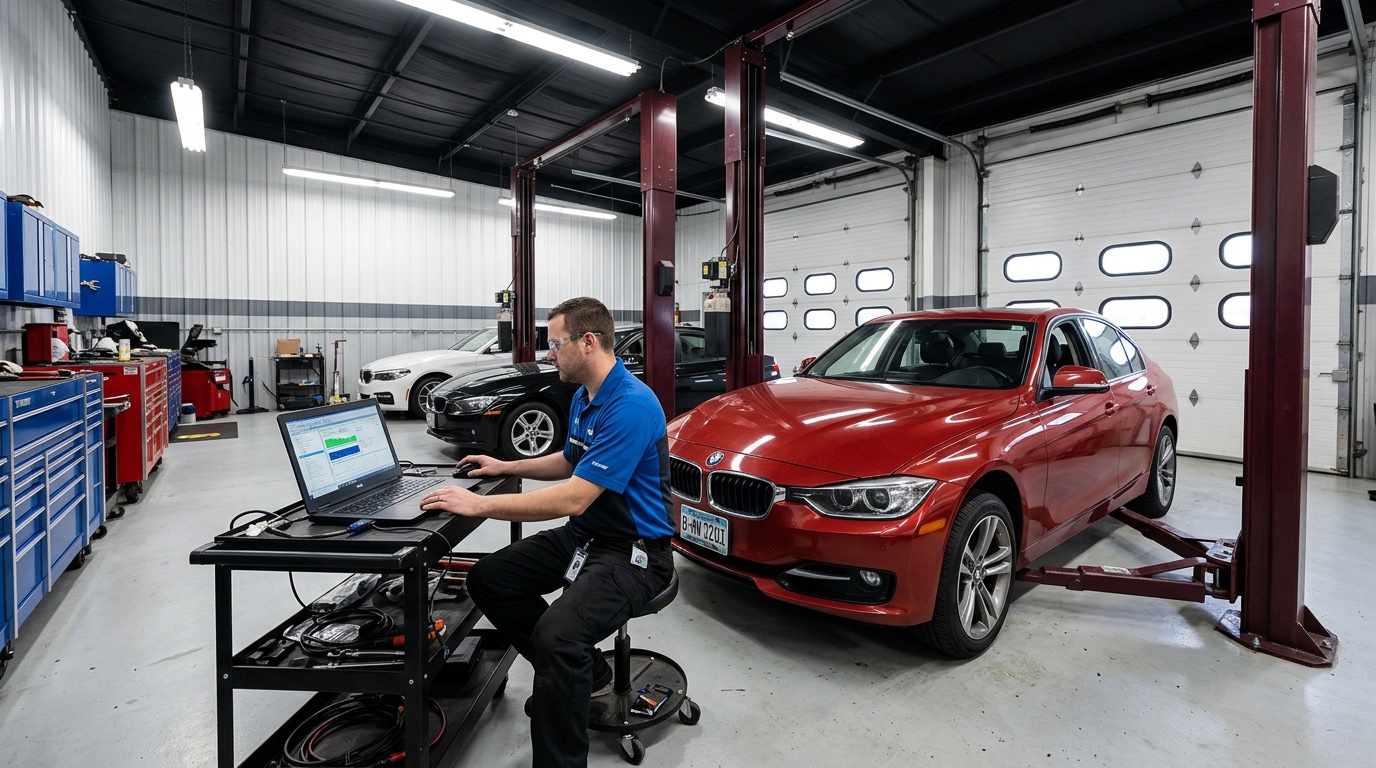
Few topics in the BMW world generate more excitement — and more misinformation — than coding and programming. Browse any BMW forum and you'll find threads claiming you can unlock hidden horsepower, enable features your car doesn't have, and transform your base model into an M car with just a laptop and a cable. Some of that is true. Most of it isn't.
At Highline, we perform BMW coding regularly and we've seen both the genuine value it provides and the damage that bad information (or bad coding) can cause. Let's separate fact from fiction.
Coding vs. Programming vs. Flashing: What's the Difference?
These three terms are often used interchangeably, but they refer to very different operations:
Coding
Coding is changing configuration settings within existing module software. Think of it like changing settings in an app — the app itself doesn't change, but its behavior does. Coding modifies parameters in the vehicle's control modules to enable, disable, or adjust features.
- What changes: Feature flags, threshold values, behavior settings
- What doesn't change: The module's base software
- Risk level: Low (reversible, no software modification)
- Example: Enabling ambient lighting colors, changing auto-lock behavior
Programming
Programming is updating or replacing the module's firmware/software. This is equivalent to updating your phone's operating system. The module gets new base software that may include new features, bug fixes, or calibration changes.
- What changes: The module's entire software package
- Risk level: Medium to high (can brick modules if interrupted or done incorrectly)
- When needed: Module replacement, software recalls, adding new hardware (e.g., retrofitting a feature)
- Example: Updating the iDrive head unit to a newer software version
Flashing
Flashing is writing a modified calibration to the DME or TCU — this is what tuning companies like BM3 and MHD do. It changes the engine or transmission control parameters to modify performance characteristics (boost levels, fuel maps, transmission shift points, etc.).
- What changes: Performance calibration data within the DME/TCU
- Risk level: Medium (reversible with proper tools, but affects emissions and warranty)
- Example: Installing a Stage 1 BM3 tune for more power
Key point: When most people say "coding," they actually mean coding (configuration changes). It's the least risky and most commonly requested of the three operations.
What Coding CAN Do
Here's where coding genuinely delivers value. These are real, commonly requested coding changes that work on most BMW models:
Comfort & Convenience
- Fold mirrors on lock/unlock — mirrors fold when you lock the car and unfold when you unlock
- Auto start-stop default off — the engine auto start-stop remembers your last setting (or defaults to off)
- Comfort access tweaks — adjusting the proximity and behavior of keyless entry/start
- Window behavior — one-touch up/down for all windows, close windows with key fob hold
- Seatbelt warning disable — remove the persistent chime (note: safety consideration)
- Lock/unlock confirmation sounds — horn chirp or just visual confirmation
Lighting
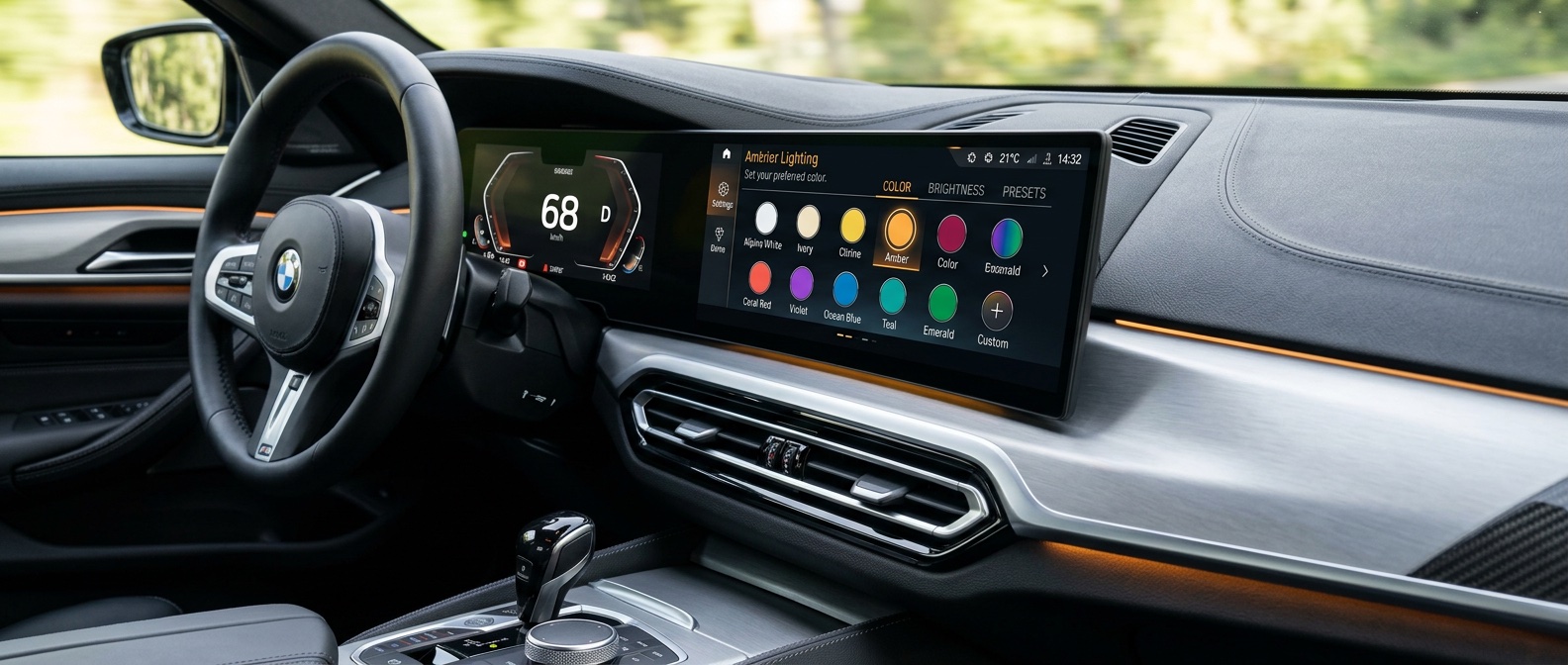
- Ambient lighting colors — unlock additional color options in the iDrive menu
- Daytime running light options — adjust brightness, enable/disable specific elements
- Welcome light patterns — customize the light show when approaching the car
- Fog light as cornering light — activate fog lights during turns for better visibility
Digital & Display
- Digital speedometer in instrument cluster — add a numerical speed readout
- Sport displays — enable additional gauge displays (oil temp, boost, power/torque meters)
- iDrive layout changes — rearrange tiles, enable hidden menu items
- Disable iDrive disclaimer screen — remove the "caution" screen on startup
Driving Dynamics
- Sport display enhancements — more detailed performance data
- Exhaust burble/crackle — enable sport exhaust sound in sport/sport+ modes (where hardware supports it)
- Launch control — enable on models that have the hardware but not the software activation
What Coding CAN'T Do
This is where the myths live. Here's what coding cannot accomplish, despite what forums and social media might claim:
Add Hardware Features That Don't Exist
If your car doesn't have heated seats, coding can't create heat. If you don't have a heads-up display projector, coding can't project anything onto your windshield. Coding activates or adjusts software — it can't create hardware.
- ❌ Can't add heated seats without heating elements
- ❌ Can't enable heads-up display without the projector
- ❌ Can't add surround view cameras without the physical cameras
- ❌ Can't enable wireless CarPlay without the compatible antenna module
Unlock Horsepower Without a Tune
This is the biggest myth. Coding does not change engine calibration data — it can't increase boost, advance timing, or modify fuel maps. If you want more power, you need a proper tune (flash), not coding. Anyone claiming they can code 50hp is either confused about terminology or misleading you.
Bypass Safety Systems
Modern BMWs have safety-critical systems that are deliberately protected from coding changes:
- ❌ Can't disable airbag systems
- ❌ Can't remove speed limiters on current models (hardware-enforced)
- ❌ Can't bypass emissions controls (SCR, DPF, catalytic converters)
- ❌ Can't disable stability control permanently on most newer models
Make a Base Model into an M
You can code M-style digital gauges or sport displays, but you can't code an M differential, M brakes, or M engine calibration into a non-M car. The hardware differences between a 340i and an M3 are fundamental.
Important: Be very skeptical of anyone advertising "performance coding" that claims to increase horsepower. Legitimate power increases come from ECU tuning (flashing), which is a completely different process requiring specialized calibration files.
Common Myths Debunked
- "I coded my car and got 20hp" — No. You may have enabled a sport display that shows higher numbers, or the butt-dyno is strong, but coding doesn't change power output
- "You can code Apple CarPlay for free" — On some older models, yes (if the hardware exists). On newer models, BMW has locked this behind their Connected Drive subscription, and coding around it has become increasingly difficult
- "Coding voids your warranty" — Not automatically. BMW would need to prove that a specific coding change caused a specific failure. However, dealer attitudes vary widely
- "You can brick your car by coding" — Coding (configuration changes) is very unlikely to brick anything because it's reversible. Programming (software changes) can absolutely brick a module if done wrong
The Tools: E-Sys vs. ISTA vs. Aftermarket
E-Sys
BMW's engineering-level software for F-series and G-series coding. It's the most powerful coding tool available, with access to essentially every configurable parameter. However, it has a steep learning curve, requires proper token files (PSdZData / CAFD files), and can be dangerous in inexperienced hands.
ISTA
BMW's dealer diagnostic and programming software. ISTA excels at module programming, diagnostics, and vehicle-level operations. It's less granular for feature coding than E-Sys but essential for programming work.
Aftermarket Apps (BimmerCode, Carly, xHP)
These consumer-friendly apps simplify common coding changes into a point-and-click interface. They're safe, easy to use, and cover the most popular coding options. However, they only expose a fraction of the parameters that E-Sys can access.
Risks of Bad Coding
While coding is generally safe, there are real risks when done incorrectly:
- Module communication errors — incorrect coding can cause modules to stop communicating with each other, triggering warning lights and disabled features
- Battery drain — coding a module to stay awake when it should sleep can drain your battery overnight
- Feature conflicts — enabling features that conflict with your vehicle's hardware configuration can cause unpredictable behavior
- Dealer resets — BMW dealers may reflash modules to factory settings during service visits, erasing your coding changes
- Unintended consequences — changing one parameter can affect others in non-obvious ways
Highline's Coding Service
At Highline, we offer BMW coding as a standalone service. Our approach:
- Consultation — we discuss what you want to change and confirm what's actually possible on your specific vehicle
- Pre-coding backup — we save your current module configurations before making any changes
- Professional coding with E-Sys and ISTA — using BMW's own tools for reliable, clean coding
- Verification — testing every coded feature to confirm it works correctly
- Documentation — we note what was changed so it can be referenced or reverted if needed
We also provide honest guidance on what's worth coding and what's not. Some coding changes are genuinely useful (fold mirrors, digital speedometer, start-stop default). Others are novelty items that may cause more headaches than they're worth. We'll tell you the difference.
Interested in BMW Coding?
Let Highline customize your BMW's features with professional E-Sys coding — backed by experience and proper tools, not forum guesswork.