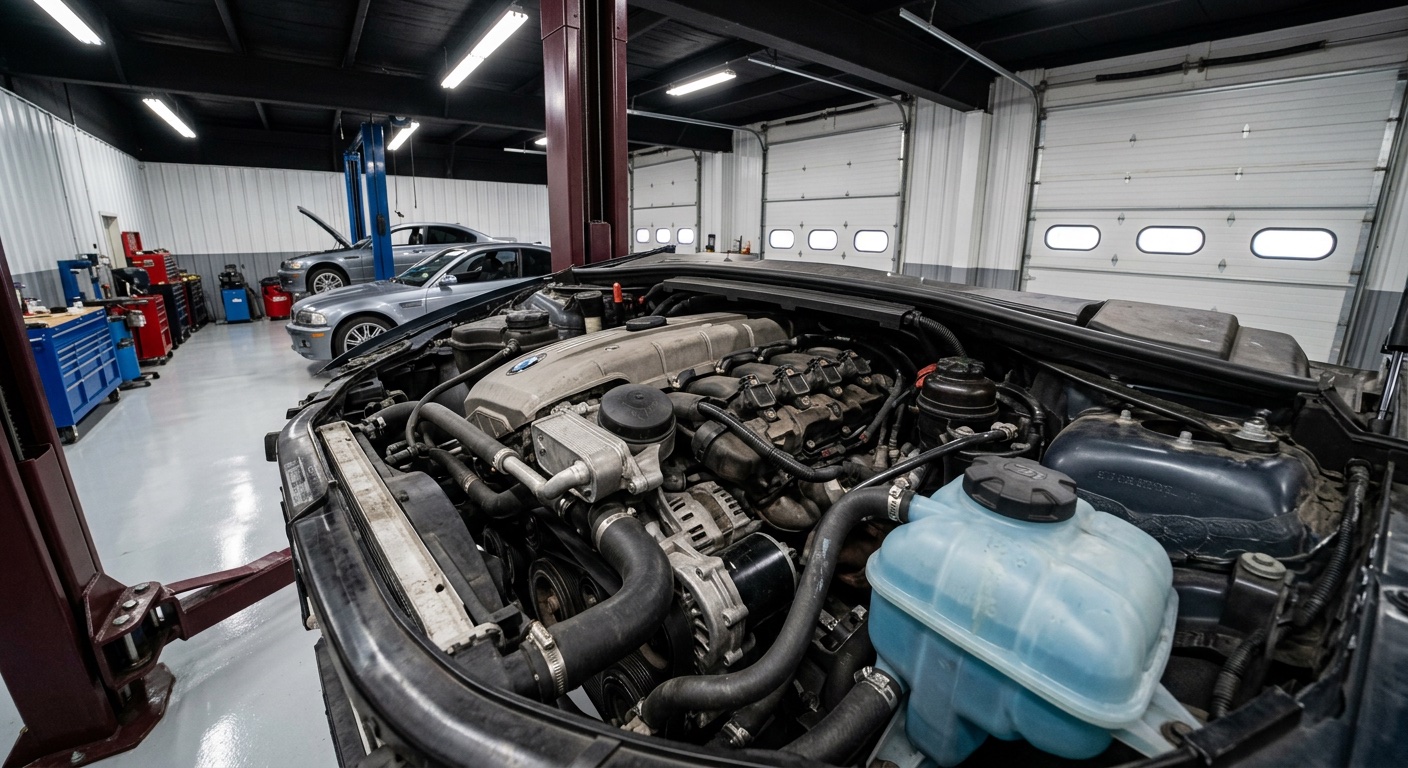
If you've owned a BMW long enough, you've either experienced a coolant leak or you will. It's not a question of if — it's a question of when. BMW's cooling systems are well-engineered for performance and efficiency, but they're built with materials that have a finite lifespan. And when cooling system components fail, the consequences can range from a $200 hose replacement to a $8,000+ engine rebuild.
The difference between those two outcomes? Preventive maintenance. Understanding how BMW's cooling system works and when to replace components before they fail is the single best thing you can do to protect your engine investment.
Why BMW Uses Plastic (And Why It Matters)
Walk up to any BMW engine and look at the cooling system. You'll notice something immediately: almost everything is plastic. The expansion tank, thermostat housing, water pump housing, coolant pipe connectors, and many hose junctions are all made from high-temperature engineered plastic rather than aluminum or steel.
BMW made this choice for legitimate engineering reasons:
- Weight savings — plastic components weigh significantly less than metal equivalents, improving power-to-weight ratio and fuel efficiency
- Cost efficiency — plastic injection molding is cheaper than casting aluminum
- Corrosion resistance — plastic doesn't corrode from coolant interaction like aluminum can
- Complex geometry — plastic can be molded into shapes that would be difficult or expensive to machine from metal
The problem? Plastic degrades with heat cycling. Every time the engine heats up and cools down, the plastic components expand and contract. Over thousands of cycles, the material becomes brittle. Hairline cracks form. Sealing surfaces warp. And eventually, something lets go — often with very little warning.
The Failure Cascade
Here's why cooling system failures are so dangerous on BMWs. Unlike a gradual oil leak that you might notice and monitor, a coolant system failure can go from "fine" to "catastrophic" in minutes. Here's the typical progression:
- Component develops a crack — a small coolant weep begins, possibly only visible as a stain or slight steam smell
- Crack propagates — heat cycling widens the crack, coolant loss increases
- Expansion tank loses pressure — the system can no longer maintain the 1.5+ bar pressure needed to raise the coolant's boiling point
- Coolant level drops — the electric water pump may cavitate (pump air instead of coolant)
- Engine overheats — temperatures spike rapidly once coolant circulation is compromised
- Head gasket failure — or worse, a warped cylinder head, cracked block, or spun bearing
Critical: BMW's temperature gauge is deliberately damped — it stays at the 12 o'clock "normal" position across a wide temperature range. By the time the gauge moves into the red zone, the engine may already be dangerously overheated. Don't rely on the gauge alone.
The Expansion Tank: BMW's #1 Coolant Failure
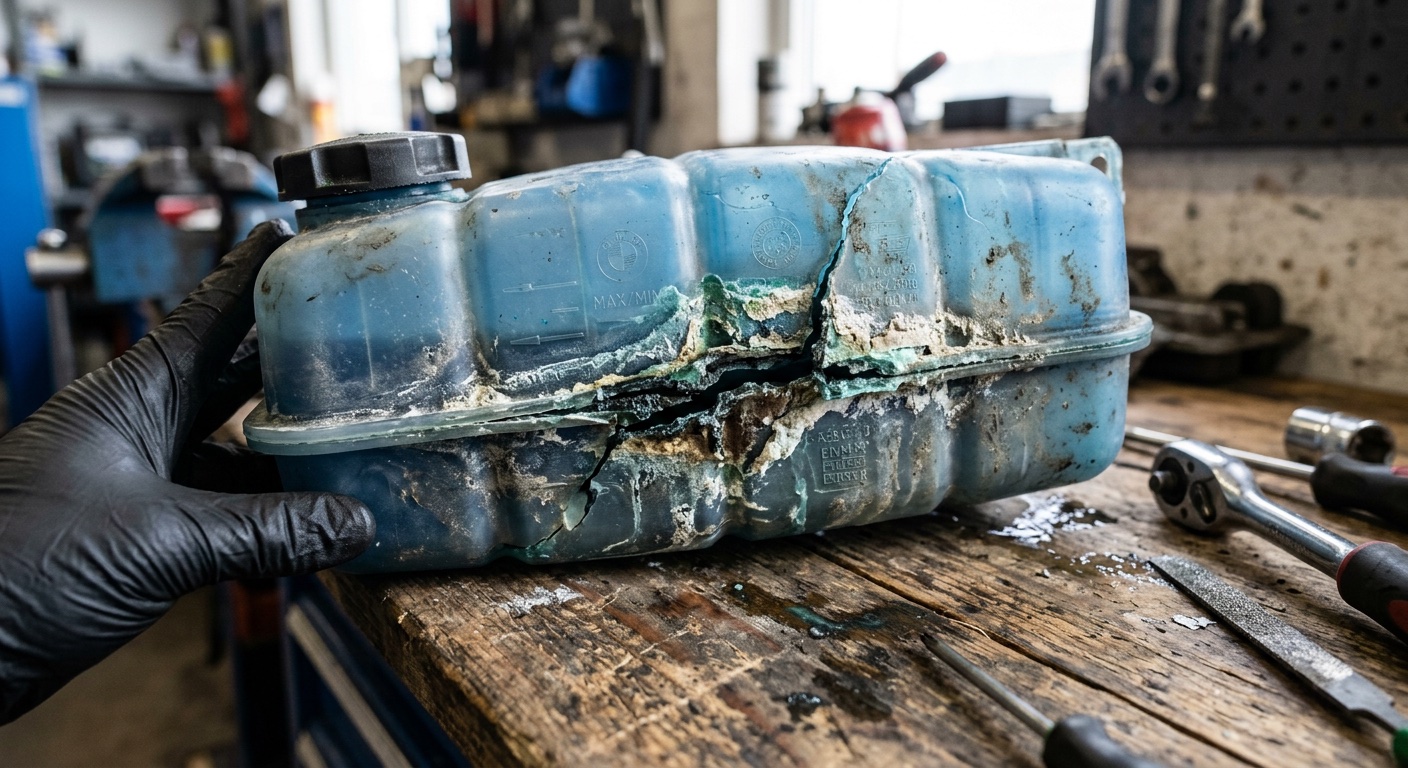
If there's one cooling system component that defines the BMW ownership experience, it's the expansion tank (also called the coolant reservoir). These tanks are pressurized — they're not passive overflow reservoirs like on many other cars. They're structural components that hold the system's operating pressure.
BMW expansion tanks fail because:
- Constant pressure cycling — the tank pressurizes every time the engine runs and depressurizes when it cools
- Heat exposure — the tank sits in the engine bay, absorbing radiant heat
- Material fatigue — the plastic becomes brittle after ~60,000-80,000 miles
- Seam failure — the two-piece molded construction has a seam that's the most common failure point
A cracked expansion tank can go from a small seep to a complete burst while driving, dumping all the coolant in seconds. This is one of the most common reasons we see BMWs towed to our shop with overheating damage.
Electric Water Pump Failures
Starting with the N52 engine (2006+), BMW moved from a traditional belt-driven water pump to an electric water pump. This was a smart engineering move — an electric pump can run at variable speeds, continue circulating coolant after engine shutdown (thermal soak protection), and doesn't steal horsepower from the engine.
But electric water pumps have their own failure modes:
- Impeller failure — early N52 pumps had plastic impellers that could crack or separate from the motor shaft
- Electronic control failure — the pump's internal controller can fail, stopping the pump entirely
- Bearing wear — the pump shaft bearings wear over time, eventually causing noise and then seizure
- Coolant contamination — if old coolant isn't replaced, deposits can damage the pump internals
The engines most commonly affected by electric water pump failures:
- N52 — the first generation electric pump was the most failure-prone
- N54/N55 — improved over the N52 but still a common failure item after 80K miles
- N20/N26 — 4-cylinder turbo engines with similar pump designs
- B58 — newer and more reliable, but not immune at higher mileage
Key point: When an electric water pump fails, there's no belt squealing or gradual power steering loss to warn you — the pump simply stops. The engine can overheat in minutes, especially in traffic or under load.
Thermostat Housing Leaks
The thermostat housing is another plastic component that sits directly against the engine block, exposed to the highest temperatures in the cooling system. BMW thermostats are electronically controlled (the DME can command the thermostat open or closed to optimize engine temperature), which adds electrical connectors to the plastic housing — more potential leak points.
Thermostat housing failures typically present as:
- Coolant dripping from the front of the engine — visible on the ground or on engine components
- Sweet smell from the engine bay — coolant hitting hot engine surfaces
- Erratic temperature readings — if the thermostat itself fails (stuck open or closed)
- Coolant in the oil — in severe cases where the housing cracks at the engine block mating surface
Coolant Hose Deterioration
BMW uses a combination of rubber and silicone hoses throughout the cooling system. The main hoses (upper and lower radiator hoses) tend to be fairly durable, but the smaller hoses and quick-connect fittings are where problems hide:
- Heater core hoses — routed through the firewall, difficult to inspect
- Turbo coolant lines — smaller diameter, high heat exposure on turbocharged engines
- Quick-connect fittings — plastic clips that become brittle and snap, releasing hoses under pressure
- Bleeder screw housings — small plastic components that crack when overtightened or from heat cycling
The Preventive Replacement Schedule BMW Won't Tell You
BMW's official maintenance schedule treats many cooling system components as "inspect and replace as needed." In practice, this means most owners don't replace anything until it fails — often catastrophically. Based on years of experience working on these engines, here's what we recommend:
At 60,000-80,000 Miles
- Expansion tank — replace regardless of condition (it's preventive, not reactive)
- Thermostat and housing — replace the entire assembly, not just the thermostat
- Radiator hoses — upper, lower, and any auxiliary hoses showing hardness or cracks
- Coolant flush and refill — with BMW-spec coolant mixed to proper concentration
At 80,000-100,000 Miles
- Electric water pump — preventive replacement if original, especially on N52/N54/N55
- Radiator — if plastic end tanks show any signs of weeping or discoloration
- Heater core hoses — replace while accessible if doing other cooling work
The Complete Coolant System Overhaul
Many owners choose to do a full cooling system overhaul at the 60-80K mark — replacing the expansion tank, thermostat housing, water pump, hoses, and coolant in one service. This is the most cost-effective approach because much of the labor overlaps, and it essentially resets the cooling system's lifespan for another 60-80K miles.
Warning Signs You Shouldn't Ignore
- Low coolant warnings — even if the level "looks fine" in the tank, the sensor is telling you something
- Sweet smell from engine bay or vents — coolant hitting hot surfaces or leaking into the heater core
- White residue on engine components — dried coolant from a slow leak
- Steam from under the hood — obvious, but some owners dismiss small amounts of steam in cold weather
- Temperature gauge above center — on a BMW, even slightly above center is cause for concern
- Coolant puddles under the car — blue-green fluid (BMW coolant) on your garage floor
Highline's Coolant System Service
At Highline, cooling system maintenance is one of our most recommended preventive services for BMWs approaching the 60-80K mile mark. Our process includes:
- Pressure testing — pressurizing the system to identify even the smallest leaks
- Visual inspection — checking every plastic component, hose, and connection point for degradation
- Component replacement — using OE or OE-equivalent parts (Rein, URO Premium, or genuine BMW)
- Proper bleeding — BMW cooling systems are notoriously difficult to bleed properly; air pockets cause hot spots and overheating
- System verification — monitoring temperatures through multiple heat cycles to confirm proper operation
Prevent the Overheat — Service Your Coolant System
A proactive cooling system overhaul at 60-80K miles is the best insurance against a catastrophic overheat. Let Highline keep your BMW running cool.