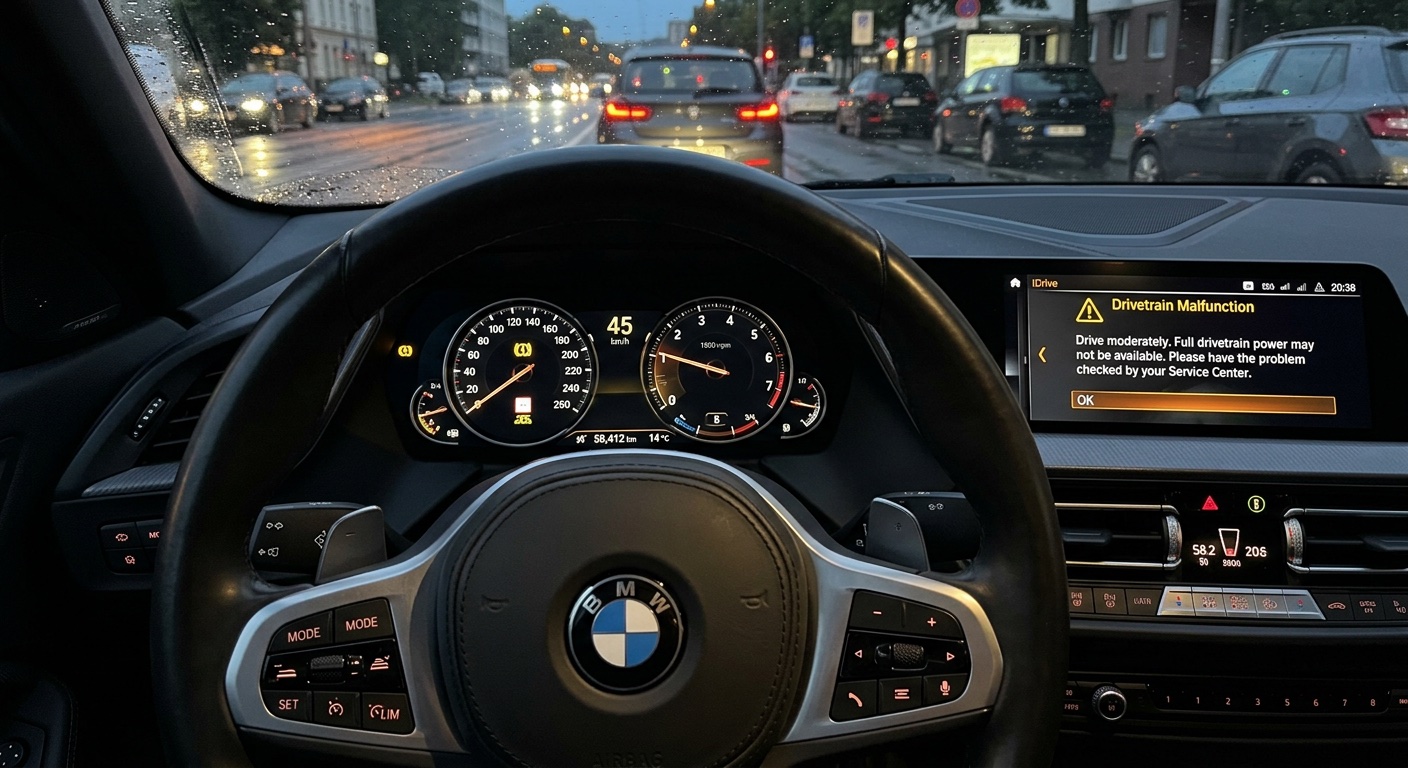
You're driving along and suddenly your BMW's iDrive screen flashes a yellow triangle with the dreaded message: "Drivetrain Malfunction — Drive Moderately." Your heart drops. Your power drops. And now you're wondering if you're about to be stranded or facing a five-figure repair bill.
Take a breath. The drivetrain malfunction warning is one of BMW's most common — and most misunderstood — alerts. It's essentially a catch-all message that covers everything from a loose gas cap to a failing turbocharger. The key is understanding what's actually going on underneath, and that requires proper BMW-specific diagnostics.
What Triggers the Warning
The "Drivetrain Malfunction" message is BMW's generic response to any fault detected in the powertrain system. Unlike specific warnings (like "Low Oil" or "Coolant Temperature"), this one is deliberately vague because it can be triggered by dozens of different components. The DME (engine control unit) detects an anomaly, determines it could affect drivability or emissions, and displays the warning.
The message is often accompanied by:
- Reduced engine power — the DME limits output to protect components
- Check Engine Light (CEL) — may appear simultaneously or was already on
- Limp mode activation — in severe cases, the car limits speed to ~40-60 mph
- Rough idle or misfires — depending on the root cause
- Turbo boost reduction — the DME cuts boost pressure as a protective measure
The Most Common Causes
After diagnosing thousands of drivetrain malfunction warnings at Highline, here are the causes we see most frequently, roughly in order of prevalence:
1. Ignition Coils and Spark Plugs
This is the #1 cause across nearly every BMW engine family. Ignition coils are wear items that fail gradually — or sometimes suddenly. When a coil weakens or dies, the cylinder misfires, the DME detects unburned fuel hitting the catalytic converter, and the drivetrain malfunction warning appears. Spark plugs that are worn or fouled produce the same result.
- Typical interval: Coils last 50-80K miles; plugs should be replaced every 45-60K miles
- Common on: Every BMW engine, but especially N54, N55, B58, N63
- Severity: Moderate — safe to drive short distances, but continued driving risks catalytic converter damage
2. High-Pressure Fuel Pump (HPFP)
The high-pressure fuel pump is responsible for delivering fuel at extremely high pressures (200+ bar) to the direct injection system. When it starts failing, fuel pressure drops, the engine runs lean, and the drivetrain malfunction warning triggers — often with a hard power cut.
- Symptoms: Long cranking, hesitation under acceleration, sudden power loss
- Common on: N54 (infamous for this), N55, B58
- Severity: High — can leave you stranded if the pump fails completely
3. VANOS Solenoids
BMW's variable valve timing system relies on oil-operated solenoids to adjust camshaft timing. When these solenoids get clogged with oil deposits or fail electrically, the DME can't properly control valve timing and throws the drivetrain malfunction warning.
- Symptoms: Rough idle, poor fuel economy, reduced power, rattling at cold start
- Common on: N52, N54, N55, S54, S65
- Severity: Low to moderate — usually safe to drive, but performance suffers
4. Turbocharger and Boost System Issues
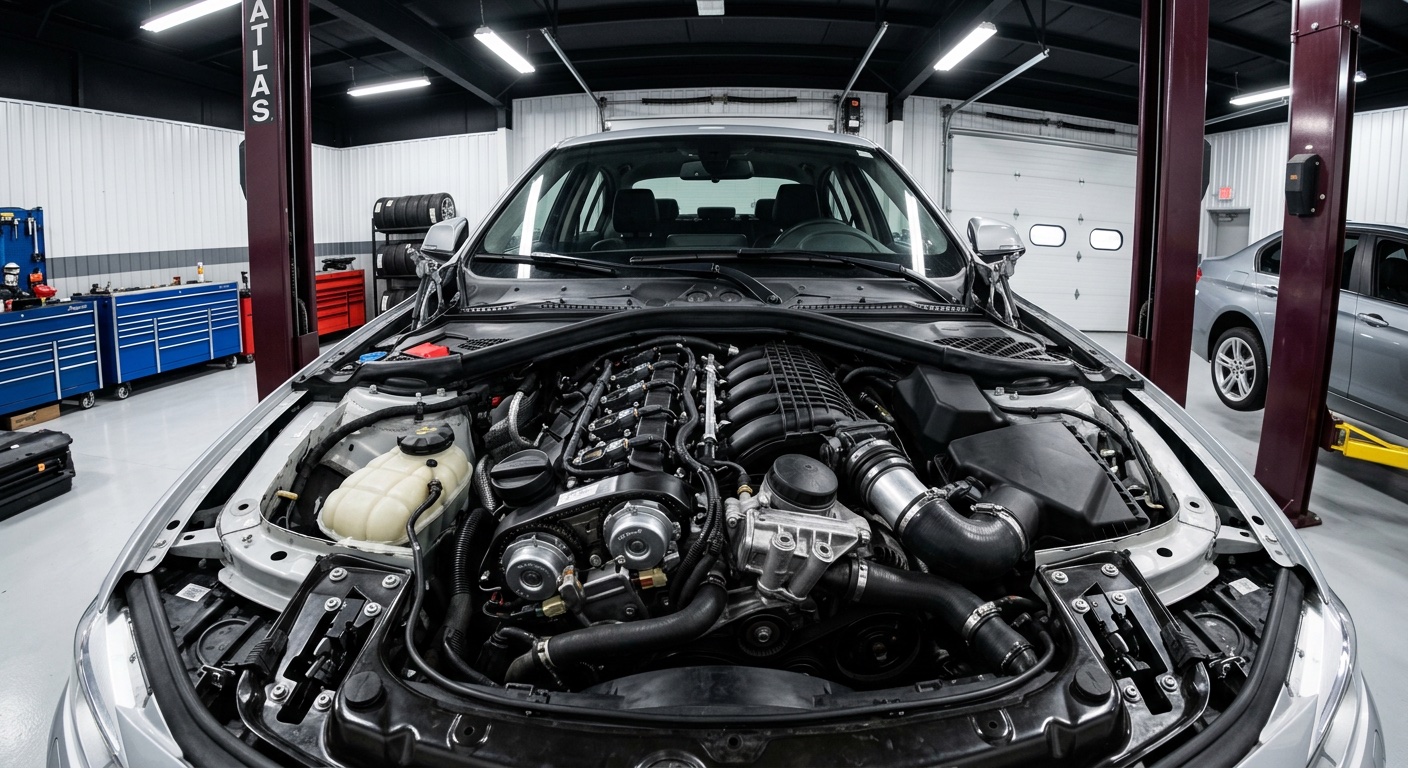
On turbocharged BMWs (which is most of them now), any leak or failure in the boost system triggers the warning. This includes the turbo itself, charge pipes, intercooler hoses, wastegate actuators, and boost pressure sensors.
- Symptoms: Whooshing sound, significant power loss, excessive smoke
- Common on: N54 (twin turbo), N55, B58, N63
- Severity: Varies — a popped charge pipe is cheap; a failed turbo is not
5. Fuel Injectors
Direct fuel injectors operate under extreme pressure and heat. Over time, they can develop deposits, stick open, or fail to atomize fuel properly. The result is uneven combustion, misfires, and — you guessed it — the drivetrain malfunction warning.
- Symptoms: Rough idle, misfire codes, fuel smell, poor fuel economy
- Common on: N54, N55, N63, B58 (less common on B58)
- Severity: Moderate — driving with a leaking injector risks engine damage
6. Mass Airflow (MAF) Sensor / Oxygen Sensors
Sensor failures can trigger the warning even when mechanical components are fine. A dirty or failed MAF sensor feeds incorrect air mass data to the DME, causing fueling errors. Failed oxygen sensors cause similar issues with fuel trim and emissions control.
Key point: The causes listed above account for roughly 85% of the drivetrain malfunction warnings we see. But because it's a catch-all warning, there are dozens of other possible triggers — from transmission issues to catalytic converter efficiency codes to wiring faults.
The Severity Spectrum
Not all drivetrain malfunction warnings are created equal. Understanding the severity helps you decide what to do next:
Level 1: Warning Only (No Power Reduction)
The message appears briefly and may even clear on its own after restarting the car. This usually indicates a momentary sensor glitch, a single misfire event, or a borderline emissions reading. You can usually continue driving, but should get it scanned soon.
Level 2: Reduced Power (Soft Limp Mode)
The warning stays on, and you notice reduced throttle response and power. The DME is actively limiting output to protect components. You can drive to a shop, but avoid hard acceleration or highway speeds if possible.
Level 3: Hard Limp Mode
The car limits you to 40-60 mph with severely restricted power. The transmission may lock into a single gear. This indicates the DME has detected a condition that could cause immediate damage. Drive directly to a shop or have it towed.
Important: If the drivetrain malfunction warning is accompanied by a red temperature warning, oil pressure warning, or the car is producing heavy smoke — pull over immediately and shut off the engine. These combinations indicate potentially catastrophic failures.
Why Generic Code Readers Aren't Enough
Here's where many BMW owners get led astray. You grab an OBD2 scanner from the auto parts store, pull codes, and get something vague like P0300 — Random/Multiple Cylinder Misfire. That tells you almost nothing about the actual cause.
BMW's systems generate manufacturer-specific fault codes that provide far more detail than generic OBD2 codes. Using BMW-specific diagnostic software like ISTA, we can see:
- BMW-specific fault codes with detailed freeze frame data
- Which cylinder is misfiring and under what conditions
- Real-time sensor data — fuel pressure, boost pressure, injection timing, coil dwell time
- Adaptation values — how far the DME has deviated from baseline to compensate
- Fault history — stored faults that may have cleared but point to intermittent issues
A generic scanner might tell you "misfire detected." ISTA tells you "Cylinder 4 misfire, fuel trim bank 2 running +14% lean, injection quantity correction at maximum, high-pressure fuel pump delivery below threshold at 2,800 RPM." That's the difference between guessing and diagnosing.
Highline's Diagnostic Process
When you bring a drivetrain malfunction warning to Highline, here's our approach:
- Full fault code scan with ISTA — reading all modules, not just the DME
- Freeze frame analysis — understanding exactly what conditions triggered the fault
- Live data monitoring — watching real-time sensor values under various driving conditions
- Component testing — targeted testing of suspected components based on diagnostic data
- Root cause identification — confirming the actual cause before recommending any repairs
- Clear communication — explaining what's wrong, what it will cost, and what's optional vs. urgent
We don't throw parts at problems. We diagnose them. That saves you money and gets your BMW back to proper operation the first time.
Got a Drivetrain Malfunction Warning?
Don't guess — get a proper BMW-specific diagnosis with ISTA. Highline's factory-trained technicians will identify the root cause and give you clear options.