You hop in your BMW one morning and the interior lights are dark, the windows and mirrors won't move, or the headlights are stuck on or off. Maybe your diagnostic tool suddenly can't communicate with the body module at all. A trip to the dealer often ends with the same diagnosis: a failed FRM (Footwell Module) — and a replacement quote of $1,500+.
Before you write that check, know this: Highline Motorsports offers FRM3-only bench repair with same-day service. We provide mail-in repair (return shipping included) and local drop-off. After repair, the module is plug-and-play with no coding required. We repair circuit-level failures only — physical damage is not covered.
What Is the BMW FRM (Footwell Module)?
The FRM — Footwell Module — is one of the most critical electronic control modules in your BMW. Later E-series models use the FRM3 version, and Highline's repair service is for FRM3 units only (we do not repair FRM1 or FRM2). Despite its humble name (it's physically located in the driver's footwell, behind the kick panel), the FRM controls a surprisingly wide range of vehicle functions:
- Exterior lighting: Headlights (low beam, high beam, DRL), tail lights, brake lights, fog lights, parking lights, license plate lights, and cornering lights
- Turn signals and hazard lights: All indicator lighting including side markers
- Windshield wipers: Front and rear wiper operation, rain sensor integration, and intermittent timing
- Power windows: All four window regulators, including one-touch up/down and pinch protection
- Central locking: Door lock/unlock commands, including comfort access (keyless entry) integration
- Key fob communication: The FRM processes remote key signals for lock/unlock and trunk release
- Interior lighting: Courtesy lights, footwell lights, ambient lighting, glove box light
- Mirror adjustment: Power mirror control, fold function, and auto-dimming
Think of the FRM as the junction box between your body electronics. It sits on the K-CAN (body CAN bus) and PT-CAN (powertrain CAN bus) networks, receiving commands from the body domain controller and executing them through dozens of output drivers — each one a small transistor circuit that switches power to a specific device.
Common FRM Failure Symptoms
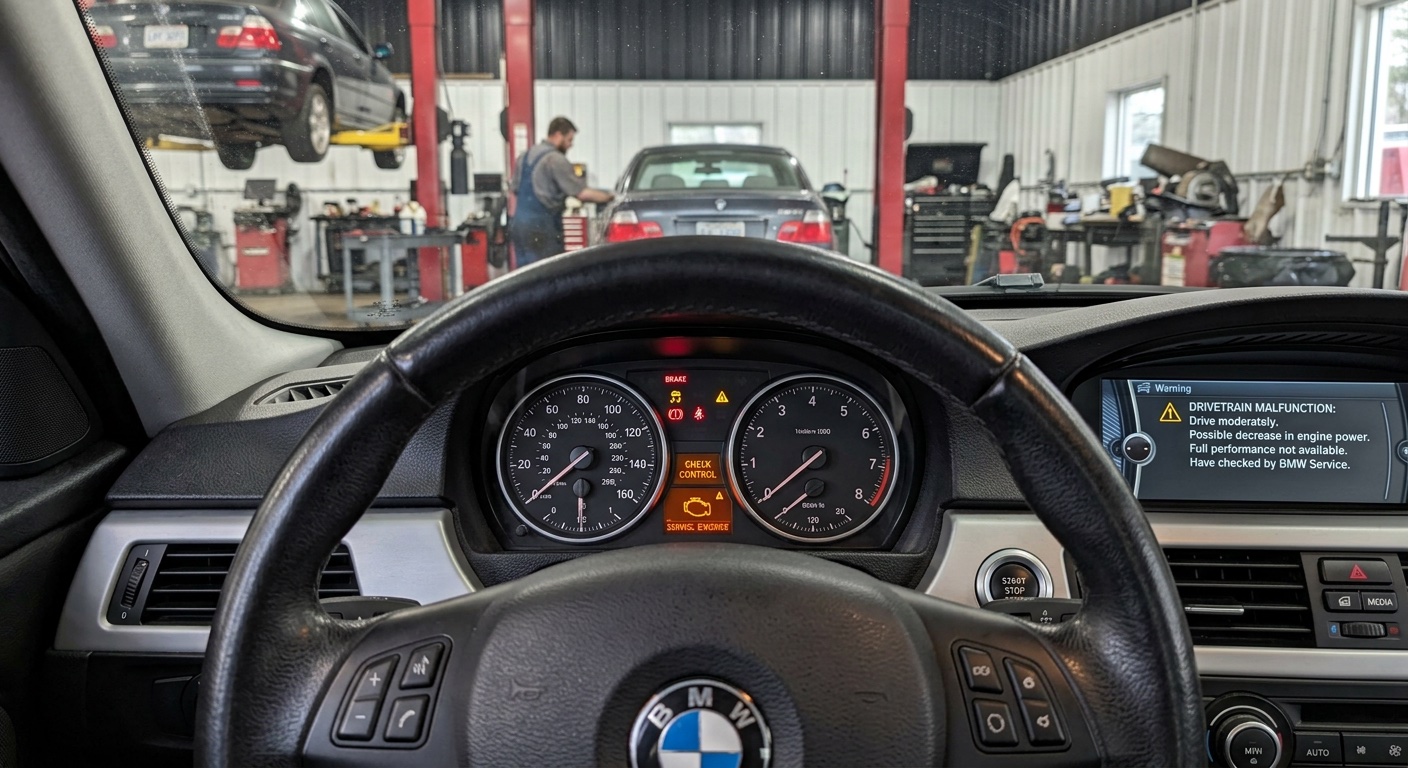
FRM failures are frustratingly varied because the module controls so many systems. Here are the most common symptoms we see at Highline:
Lighting Issues
- Headlights stuck on or off — low/high beams stay on or refuse to turn on
- Intermittent headlights — one or both headlights cutting out randomly, especially after the car warms up
- Brake lights not working — extremely dangerous; often the first sign of FRM failure
- Turn signals malfunctioning — fast blinking, no blinking, or working only on one side
- No interior lighting — cabin and footwell lights do not illuminate
- "Lamp malfunction" warnings on the dashboard with all bulbs physically working fine
Comfort & Access Issues
- Windows and mirrors not working — power windows or mirror adjustment stop responding
- Key fob not unlocking/locking doors — remote functions intermittent or completely dead
- Comfort access failure — keyless entry stops responding to door handle touch
- Wipers not working — or running at wrong speeds, rain sensor not responding
Dashboard Warnings
- Multiple warning messages appearing simultaneously (lighting, safety systems)
- Communication errors with diagnostics — scan tools can't communicate with the FRM
- Stored fault codes in the FRM pointing to internal module errors
- "Increased battery discharge" warning (the FRM may be drawing excessive power when malfunctioning)
Which BMW Models Are Affected?
The FRM module is used across a wide range of BMW models from approximately 2005 through 2017. The most commonly affected vehicles include:
- E60 / E61 — 5 Series (2004–2010)
- E63 / E64 — 6 Series (2004–2010)
- E65 / E66 — 7 Series (2002–2008)
- E70 — X5 (2007–2013)
- E71 — X6 (2008–2014)
- E87 / E82 — 1 Series (2004–2013)
- E90 / E91 / E92 / E93 — 3 Series (2006–2013)
- E89 — Z4 (2009–2016)
- F01 / F02 — 7 Series (2009–2015)
- F07 / F10 / F11 — 5 Series (2010–2017)
- F25 — X3 (2011–2017)
- F30 / F31 — 3 Series (2012–2018)
The E90 3 Series and E60 5 Series are particularly prone to FRM failures, likely due to the higher production volumes and the specific FRM hardware revisions used in these platforms.
FRM3 Repair Service Details
- FRM3 units only — we do not repair FRM1 or FRM2 modules
- Mail-in service available — ship your module to Highline, same-day repair, return shipping included
- Local drop-off and pick-up in the Capital Region
- Plug-and-play after repair — no coding required
- Much cheaper than dealer replacement while keeping your original module
Important: We perform circuit-level repairs only. Units with physical damage (cracked housings, corrosion from heavy water intrusion, or burned circuit boards) are not eligible for repair.
Why Do FRM Modules Fail?
The root cause of most FRM failures comes down to component-level failures on the circuit board, specifically:
- Output driver ICs (integrated circuits): The FRM uses small MOSFET-based driver chips to switch power to each lighting circuit. These chips handle significant current loads (headlights draw 5–10 amps per side) and generate heat. Over thousands of thermal cycles, solder joints can crack or the chips themselves can fail.
- Solder joint fatigue: The FRM's location in the footwell subjects it to temperature cycling, vibration, and occasionally moisture. BGA (Ball Grid Array) and fine-pitch SMD solder joints are vulnerable to thermal fatigue.
- Voltage spikes: Jump-starting the vehicle improperly, or battery/alternator issues causing voltage spikes, can damage sensitive driver circuits.
- Water intrusion: Though less common, a clogged cabin air filter drain or windshield seal leak can allow moisture into the footwell area, corroding the FRM's connectors or board.
Dealer Solution vs. Highline's Approach
Here's where the cost difference becomes dramatic:
The Dealer Approach
When you bring an FRM issue to the BMW dealer, their standard procedure is to replace the entire module. The new FRM module typically costs $800–$1,200 for the part, and it must be programmed (coded) with your vehicle's specific configuration data — light coding, option codes, VIN, and all the personalized settings. Programming labor adds another $300–$500. Total: $1,500+ and often closer to $2,000.
The dealer replaces the entire module because BMW doesn't support component-level repair at the dealer level. Their diagnostic process identifies the FRM as faulty and prescribes replacement — that's it.
Highline's Bench Repair Approach
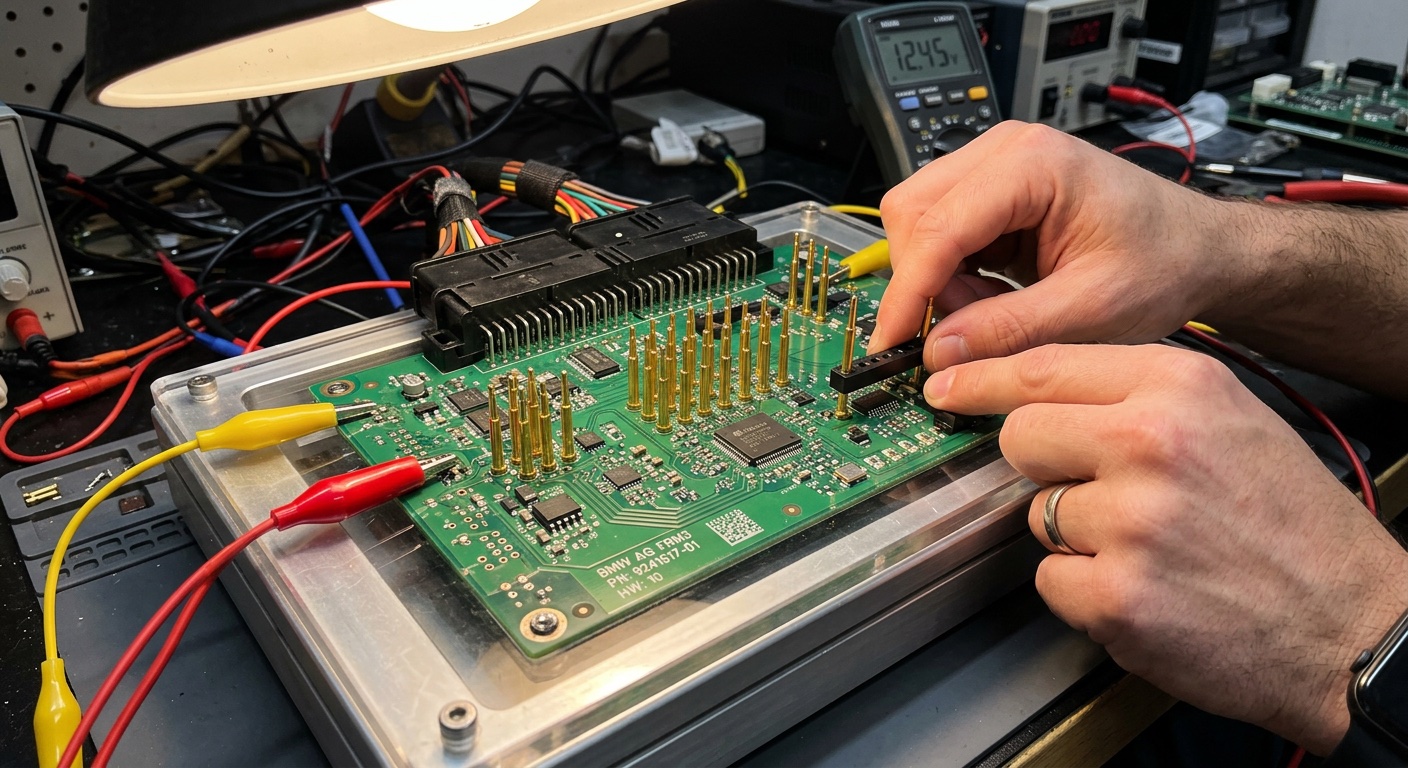
At Highline, we take a fundamentally different approach: we diagnose and repair the specific failed components on your existing FRM module. This is electronics-level work that requires specialized skills and equipment, but it saves our customers significant money.
The Bench Repair Process
Here's what our FRM repair process looks like step by step:
1. Diagnosis & Data Backup
Before removing the FRM, we perform a complete diagnostic scan to document all stored fault codes and the module's current configuration data. We back up the FRM's coding data — this is critical because it contains your vehicle's specific light coding, option settings, and VIN binding.
2. Module Removal
The FRM is carefully removed from the vehicle. It's located behind the driver's side lower kick panel, secured by a mounting bracket and connected via two large multi-pin connectors. We handle the module with ESD (electrostatic discharge) precautions throughout the process.
3. Visual & Diagnostic Inspection
On the bench, we perform a detailed visual inspection of the FRM circuit board under magnification, looking for obvious signs of component failure: burned components, cracked solder joints, corroded traces, or bulging capacitors. We then use bench diagnostic equipment to test individual output channels and identify exactly which driver circuits have failed.
4. Component-Level Repair
Once we've identified the failed components, we perform precision rework:
- Failed output driver ICs are desoldered and replaced with new, OEM-specification components
- Cracked solder joints are reflowed or rebuilt using proper hot-air and soldering station techniques
- Damaged traces are repaired with precision wire jumps
- Corroded connectors are cleaned, treated, and sealed
5. Bench Testing
After repair, the FRM is connected to our bench test setup where we verify every output channel — each lighting circuit, window control, and communication bus — before the module goes back in the vehicle.
6. Reinstallation & Programming
The repaired FRM is reinstalled in the vehicle, reconnected, and verified with a full diagnostic scan. Because your original FRM3 is repaired and retained, it's plug-and-play with no coding required in most cases.
Why Bench Repair Is the Smart Choice
- Significant cost savings: Typically 60–75% less than dealer replacement
- Preserves your original module: No need for complex reprogramming — your settings, coding, and VIN data stay intact
- Addresses the root cause: We fix the specific failed components, not just swap in a new module that could develop the same issues
- Faster turnaround: Most FRM repairs are completed within 1–2 business days
- Environmentally responsible: Repairing rather than replacing keeps electronic waste out of landfills
Don't Overpay for FRM Replacement
If your BMW has lighting issues, windows/mirrors not working, or communication errors, your FRM3 module may be the culprit. Highline offers same-day FRM3 bench repair with mail-in service and plug-and-play reinstall.