
If you've spent any time around BMW enthusiasts, you've probably heard the term "VANOS" mentioned — usually in the context of something that's gone wrong. But what exactly is VANOS, how does it work, and why does it matter so much to your BMW's performance? This guide breaks it all down.
VANOS is one of BMW's most important engineering innovations, and understanding how it works gives you a much better sense of why proper maintenance is so critical for these engines.
What Is VANOS?
VANOS stands for Variable Nockenwellen Steuerung, which is German for "variable camshaft timing" (or more literally, "variable camshaft control"). It's BMW's proprietary implementation of variable valve timing (VVT) — a technology that allows the engine's camshafts to be rotated relative to their sprockets while the engine is running, effectively advancing or retarding the timing of when the intake and/or exhaust valves open and close.
This might sound like a small adjustment, but it has a profound effect on engine performance. By optimizing valve timing for different RPM ranges and load conditions, VANOS allows a BMW engine to deliver:
- More torque at low RPM — for responsive city driving and strong off-the-line acceleration
- More horsepower at high RPM — for spirited driving and highway passing power
- Better fuel efficiency — by optimizing the combustion cycle across the entire RPM range
- Lower emissions — by ensuring more complete combustion and enabling internal EGR (exhaust gas recirculation)
- Smoother idle — by precisely controlling valve overlap at low speeds
Why it matters: Without VANOS, BMW engines would have to compromise — tuned for either low-end torque OR high-end power, but not both. VANOS gives them the best of both worlds, which is a big part of why BMW engines feel so responsive and enjoyable to drive.
Single VANOS vs. Double VANOS
BMW has evolved the VANOS system through several generations:
Single VANOS (1992–2000s)
The original VANOS system, introduced on the M50TU engine in 1992, adjusts only the intake camshaft timing. The exhaust camshaft remains fixed. This gives the engine variable control over when the intake valves open and close, which primarily affects low-to-mid RPM torque delivery.
Engines with Single VANOS:
- M50TU (E36 325i)
- M52 (E36/E39/E46 — 323i, 325i, 328i, 523i, 528i)
- S50 (E36 M3 — US spec)
Double VANOS (1998–present)
Double VANOS adjusts both the intake and exhaust camshafts independently. This provides far more precise control over the entire valve event — when valves open, when they close, and critically, how much valve overlap occurs (the period when both intake and exhaust valves are open simultaneously).
Controlling valve overlap is powerful because it allows the engine to:
- Minimize overlap at idle for smooth, stable idle quality
- Increase overlap at mid-RPM for better torque through internal EGR effects
- Optimize overlap at high RPM for maximum power output through improved volumetric efficiency
Engines with Double VANOS:
- M54 (E46/E39/E60/E83 — 2.5i, 3.0i)
- N52 (E90/E60 — 325i, 330i, 525i, 530i)
- N54 (E90/E92 335i — twin-turbo inline-6)
- N55 (F30 335i — single twin-scroll turbo inline-6)
- S54 (E46 M3)
- S65 (E90/E92 M3 — V8)
- N20/N26 (F30 328i — turbo 4-cylinder)
- B58 (G20 340i, F30 340i — current turbo inline-6)
- S58 (G80/G82 M3/M4 — current M turbo inline-6)
Essentially, every BMW engine made since the early 2000s uses Double VANOS.
How VANOS Works Mechanically
Understanding the mechanical operation of VANOS helps explain why it's sensitive to oil quality and maintenance. Here's how the system works:
The Core Components
- VANOS solenoid valves: Electronically controlled valves that direct pressurized engine oil to the VANOS actuator. The DME (engine computer) sends precise PWM (pulse-width modulated) signals to control oil flow direction and volume.
- VANOS actuator (hub/gear unit): A helical-gear mechanism mounted on the front of each camshaft. It contains a piston that, when moved by oil pressure, rotates the camshaft relative to its drive sprocket.
- Oil supply lines: Dedicated oil passages that route pressurized oil from the engine's oil system to the VANOS actuators.
- Position sensors: Camshaft position sensors that tell the DME the current angular position of each camshaft, creating a feedback loop for precise control.
The Operating Cycle
- The DME determines the ideal cam timing based on current engine RPM, throttle position, engine load, coolant temperature, and other inputs.
- The DME sends a signal to the VANOS solenoid, which is essentially an electrically operated oil valve. The signal's duty cycle determines how much oil flows and in which direction.
- Pressurized engine oil flows through the solenoid into either the "advance" or "retard" chamber of the VANOS actuator.
- Oil pressure pushes a piston inside the actuator, which is connected to the camshaft via a helical gear set. As the piston moves, the helical gears convert the linear piston movement into rotational movement of the camshaft.
- The camshaft position sensor confirms the new position, and the DME adjusts the solenoid signal to maintain the desired timing or make further corrections.
This entire cycle happens continuously and dynamically — the VANOS system is constantly adjusting camshaft timing dozens of times per second as driving conditions change.
The critical role of oil: Notice that the entire VANOS system is hydraulically operated — it uses engine oil as both its working fluid and lubricant. This means the quality, cleanliness, and pressure of your engine oil directly determines how well VANOS can function. This is why oil changes are so critically important for BMW engines — more on this below.
Common VANOS Failure Symptoms
When the VANOS system isn't working properly, you'll typically notice one or more of the following symptoms:
Performance Symptoms
- Rough or unstable idle: The engine may hunt or surge at idle, or feel rougher than normal. This is because VANOS can't properly minimize valve overlap at low RPM.
- Loss of low-end torque: The car may feel noticeably sluggish from a stop or during low-RPM acceleration. The engine might not "wake up" until higher RPMs.
- Reduced high-RPM power: The top end of the powerband may feel flat — the engine doesn't pull as hard as it should above 4,000–5,000 RPM.
- Hesitation or stumbling: During transitions between light and heavy throttle, the engine may hesitate or stumble as it can't adjust valve timing quickly enough.
- Poor fuel economy: Without optimized valve timing, the combustion process becomes less efficient, increasing fuel consumption.
Audible Symptoms
- Cold start rattle: A distinctive metallic rattling or knocking noise for the first few seconds after a cold start. This is one of the most well-known VANOS symptoms. The rattle occurs because the VANOS actuator gears have excessive play when oil pressure is low (before the oil pump has fully pressurized the system).
- Ticking or clicking noise from the front of the engine: This can indicate a worn VANOS solenoid or internal actuator wear.
Diagnostic Symptoms
- Check Engine Light (CEL): VANOS-related fault codes are among the most common stored codes in BMW engines. Common codes include 2A82 (VANOS intake slow), 2A87 (VANOS exhaust slow), and various correlation codes (2A98, 2A99).
- Failed emissions testing: Improperly timed VANOS can cause elevated emissions, particularly NOx and hydrocarbons.
Common VANOS Failure Points
Different BMW engines have different VANOS weak points. Here are the most common failures we see at Highline:
VANOS Solenoid Seal Deterioration
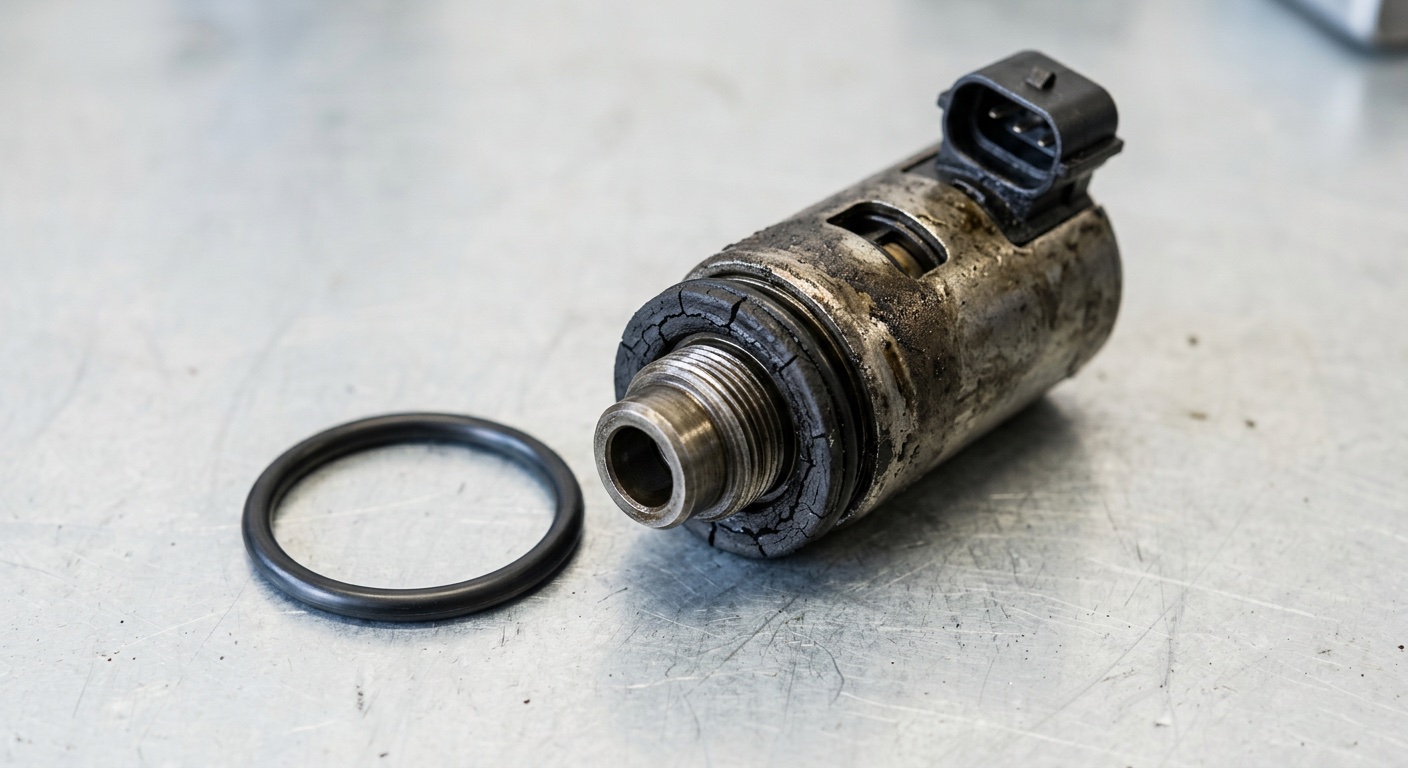
The VANOS solenoid contains small rubber O-ring seals that prevent oil from leaking past the solenoid body. Over time, these seals harden and crack due to heat and oil contamination, causing oil to bypass the solenoid. This reduces the oil pressure available to the actuator, leading to sluggish or incomplete cam timing adjustments. This is the most common VANOS-related repair across all BMW engines.
VANOS Bolt Failure (S54 / S65)
The S54 (E46 M3) and S65 (E90/E92 M3 V8) engines are known for a potentially catastrophic issue: the VANOS hub bolts can shear. These bolts secure the VANOS sprocket to the camshaft, and BMW originally used bolts that were prone to fatigue failure. When they fail, the cam timing jumps wildly, which can cause piston-to-valve contact and severe engine damage. BMW issued a service bulletin recommending replacement with updated bolts — if you have an E46 M3 or E9x M3 and haven't had this done, it should be a top priority.
Oil Supply Issues
Clogged oil passages, a failing oil pump, or simply low oil level can starve the VANOS system of the hydraulic pressure it needs. Because the VANOS actuators require clean, pressurized oil to operate, any contamination — sludge, varnish, or debris from extended oil change intervals — can clog the small passages and solenoid screens, degrading VANOS performance.
VANOS Actuator (Hub/Gear) Wear
Over very high mileage (150,000+ miles), the internal components of the VANOS actuator itself — the piston seals, helical gears, and bearings — can wear to the point where the system can no longer maintain precise cam positioning. At this point, the entire VANOS unit needs to be rebuilt or replaced.
The Connection to Oil Changes
We can't emphasize this enough: the single most important thing you can do to protect your BMW's VANOS system is to change your oil regularly with the correct specification oil.
Here's why:
- VANOS is hydraulically operated. It relies on clean, properly viscous oil delivered at adequate pressure. Degraded oil with reduced viscosity can't generate enough hydraulic force to move the VANOS actuator piston precisely.
- Contaminated oil clogs VANOS components. As oil breaks down, it forms sludge and varnish that accumulates in the small oil passages, solenoid screens, and actuator chambers. Even a small amount of buildup can impair VANOS response time.
- Abrasive particles accelerate wear. Old oil carries metallic particles and combustion byproducts that act like sandpaper on the precision-machined VANOS internal components.
- Heat-degraded oil damages solenoid seals. Oil that's been run too long loses its ability to condition and protect rubber seals, causing the VANOS solenoid O-rings to harden and crack prematurely.
BMW's recommended oil change interval of 10,000–15,000 miles is, in our professional opinion, far too long for turbocharged BMW engines. We see significantly more VANOS issues in vehicles that follow the extended interval versus those on a 5,000–7,000-mile schedule. Read our article on Common BMW Issues from Improper Oil Changes for the full breakdown.
Schedule Your VANOS Diagnosis
If your BMW has a cold-start rattle, rough idle, loss of power, or VANOS-related fault codes, don't ignore it. Early diagnosis can prevent more serious (and expensive) engine damage.